

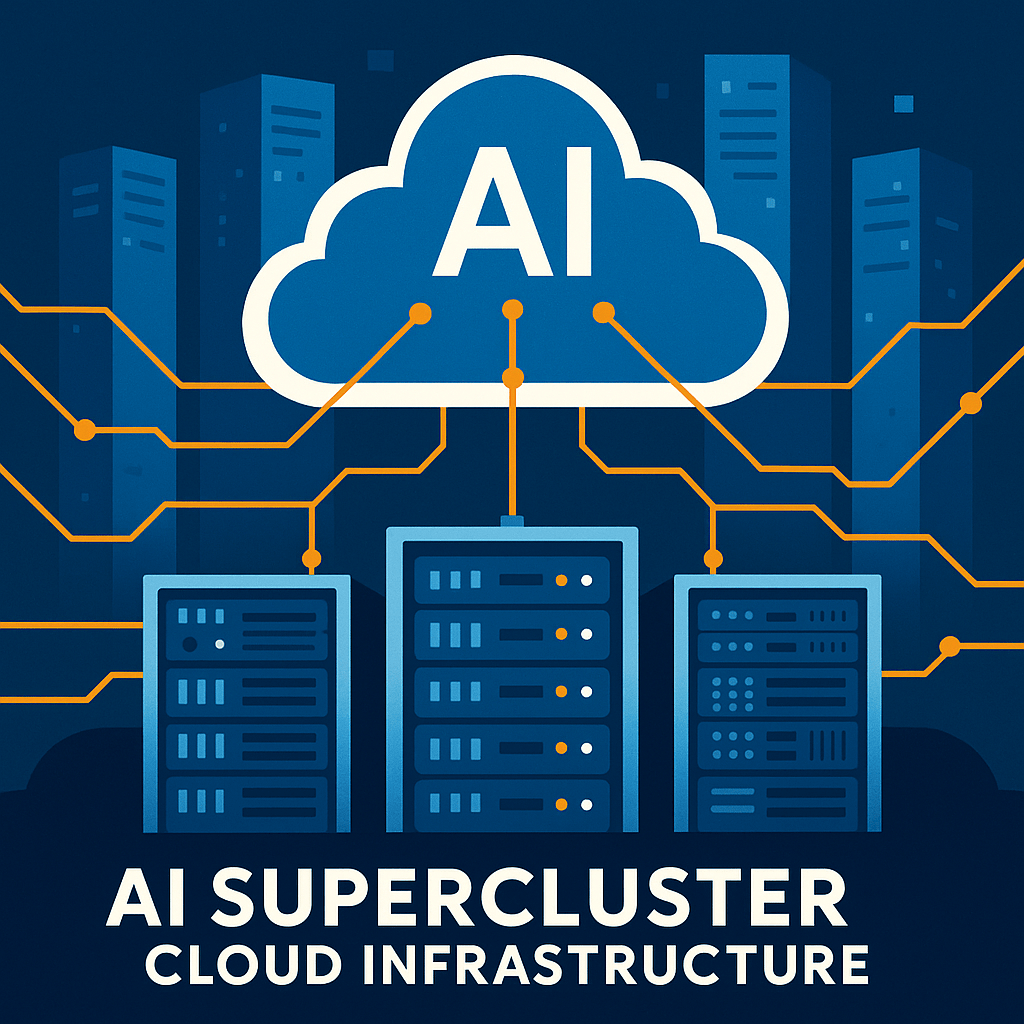
Summary : Oracle’s landmark partnership with AMD to build a publicly available AI supercluster marks a pivotal turning point in hyperscale cloud infrastructure.
In a major announcement today, Oracle and AMD revealed plans to deploy 50,000 AMD Instinct MI450 GPUs in Oracle’s cloud environment starting Q3 2026, positioning Oracle as a leading provider of AI compute infrastructure. oracle.com+2Reuters+2
This move signals a shift in the AI infrastructure landscape, accelerating access to powerful compute capacity beyond the closed walls of hyper-scale labs. Oracle’s strategy is to make an AI supercluster publicly accessible, opening doors for enterprises, AI startups, and cloud customers to push model training, fine-tuning, and inference at scale. oracle.com+1
Oracle also launched its AI Data Platform, a unified solution designed to integrate enterprise data with AI workflows and accelerate development of “agentic” applications—i.e., AI agents that can operate across systems, making recommendations and automating parts of business logic. oracle.com
Combined, these developments illustrate a broader trend: cloud providers are no longer just hosting infrastructure — they’re becoming AI enablers, offering built-in compute + data + tooling stacks.
What This Means for Cloud & AI Ecosystem
1. Democratizing AI Compute
Previously, ultra-large compute clusters were the domain of a few elite players (OpenAI, DeepMind, Anthropic). Oracle’s decision to open access changes the game: smaller AI players can tap into massive infrastructure without building it themselves.
2. Vertical Integration of Data + AI
Oracle’s AI Data Platform bridges data management and generative AI workflows. Enterprises no longer need to stitch together separate data lakes, ETL, vector stores, and inference engines—the promise is one integrated stack. oracle.com+1
This is especially useful for regulated industries (finance, healthcare, manufacturing) that require governance, lineage, privacy, and traceability built in.
3. Competitive Pressure on Hyperscalers
Oracle’s aggressive pivot puts pressure on AWS, Google Cloud, and Azure to rethink how they package AI infrastructure. They may accelerate their GPU roadmap, build more “supercloud” stacks, or offer differentiated AI services to defend market share.
4. Multi-Cloud & Partner Strategy
Alongside this, Oracle unveiled a multi-cloud services reseller program, letting partners sell “Database @AWS / Azure / GCP” offerings and providing universal cloud credits across platforms. crn.com
This acknowledges reality: most large enterprises adopt hybrid / multi-cloud strategies. Oracle is adapting by allowing integration rather than insisting on lock-in.
5. Timing & Risk Management
The 2026 timeline gives clients and ecosystems breathing space to prepare. But with compute demand rising fast, the race to lock in deals and early access will be intense.
To mitigate risk, enterprises should experiment now, validate workloads, and build AI maturity while waiting for the infrastructure fully to materialize.
Case in Point: PwC’s AI Agents in EMEA
On the same day, PwC announced scaling over 100 AI agents across EMEA in collaboration with Google Cloud, bringing its total to over 250 agents globally. PwC
These agents help automate decision workflows, compliance checks, and report generation in regulated sectors. The rollout demonstrates how enterprises are already consuming AI-enabled cloud services—not just building them.
In the future, organizations using Oracle’s upcoming supercluster might develop agents even more efficiently, leveraging both compute scale and data fusion in one platform.